
The Plan for Building a Sovereign Digital Economy.
A founder’s blueprint for building a sovereign digital economy using Web3 tools, AI development, decentralized platforms, and blockchain infrastructure.

David J. Green
BitMainStreetMarket Newsletter
The DeFi Blueprint
A founder’s note on building a sovereign digital economy, one layer at a time.
Over the past few years I’ve been paying close attention to something that most people don’t notice until it’s already happened.
Technology doesn’t change the world all at once. It changes quietly at first, underneath the surface, until one day the infrastructure is completely different.
That’s exactly what’s happening right now with decentralized technology.
Blockchain, AI-assisted development, and open financial systems are quietly creating a new layer of the internet. Not just new apps or platforms, but a completely different way for people to build and own digital systems.
For a long time, building something meaningful on the internet required a large team, serious funding, and access to specialized knowledge. Today that barrier is beginning to disappear.
The tools are becoming more powerful, and more accessible.
Over the last few years I’ve been experimenting with building systems that help people move from simply learning about Web3 to actually building with it. The idea is simple: if someone has an idea for a decentralized platform, there should be a clear path from concept to working prototype.
One of the projects that came out of this work is something called dApp Sprint.
Instead of jumping straight into code, the system starts by helping a builder clarify the idea itself. An AI assistant walks through the project step by step and produces what we call a Feeder Document — essentially the blueprint for the entire application. That document defines the purpose of the project, the features, the technology stack, and how the system should be built.
From there the project can move into structured development cycles, producing working prototypes along the way. What used to take months of planning can now happen much faster, and with a lot more clarity.
While working on that system, I also spent time developing a platform called Mint Whisper, a full-stack NFT marketplace designed to make digital asset creation and trading much more accessible. The platform supports minting, auctions, royalties, and multi-chain networks like Ethereum and Polygon.
What I find especially interesting about NFT infrastructure is the emergence of what people are starting to call phygital assets — physical items connected to digital ownership through blockchain records. When a physical object is paired with an NFT that includes verifiable provenance information, it becomes possible to track authenticity and ownership in ways that weren’t possible before.
Along the way we also built tools focused on security. Anyone who has followed the history of crypto knows that poorly written smart contracts can destroy entire projects overnight. Systems like Vault Auditor are designed to help analyze contracts before deployment so builders can identify vulnerabilities early rather than learning the hard way.
Another experiment has been a project called Satoshi For Storage, which explores how simple services can be powered directly by Bitcoin payments. The concept is straightforward: users can upload files, pay using Lightning Network payments, and share them through temporary secure links that automatically expire after a set time.
None of these projects exist in isolation. They’re part of a larger idea that I’ve been gradually shaping over time.
I call it the Sovereign Builder Network.
The idea behind the network is simple: create a space where builders can learn about decentralized systems, experiment with tools, and collaborate with others who are exploring the same ideas.
Every week we meet to discuss what we’re building, what we’re learning, and what new tools are emerging in the ecosystem. Sometimes those conversations are technical, sometimes they’re philosophical, but they all revolve around the same question:
Membership in the network currently includes access to the Power of Cryptocurrency course, upcoming training on AI prompt engineering, and the weekly builder discussions where ideas are shared and refined.
The goal isn’t simply to teach theory.
The goal is to help people actually build.
Right now the network is intentionally small. I want it to remain a place where real conversations happen and where builders can get direct feedback on what they’re creating.
For those who join early, there’s also another benefit. As new tools and platforms are developed, members will be the first to see them and the first to experiment with them.
Think of it less like a subscription and more like a group of builders working from the same blueprint.
The internet is changing again. Decentralized infrastructure, AI-driven development, and open financial systems are beginning to reshape what’s possible for independent creators and developers.
If you’re someone who has been watching this shift and wondering how to participate rather than just observe, that’s exactly why the Sovereign Builder Network exists.
We’re still early.
But that’s exactly what makes this moment interesting.
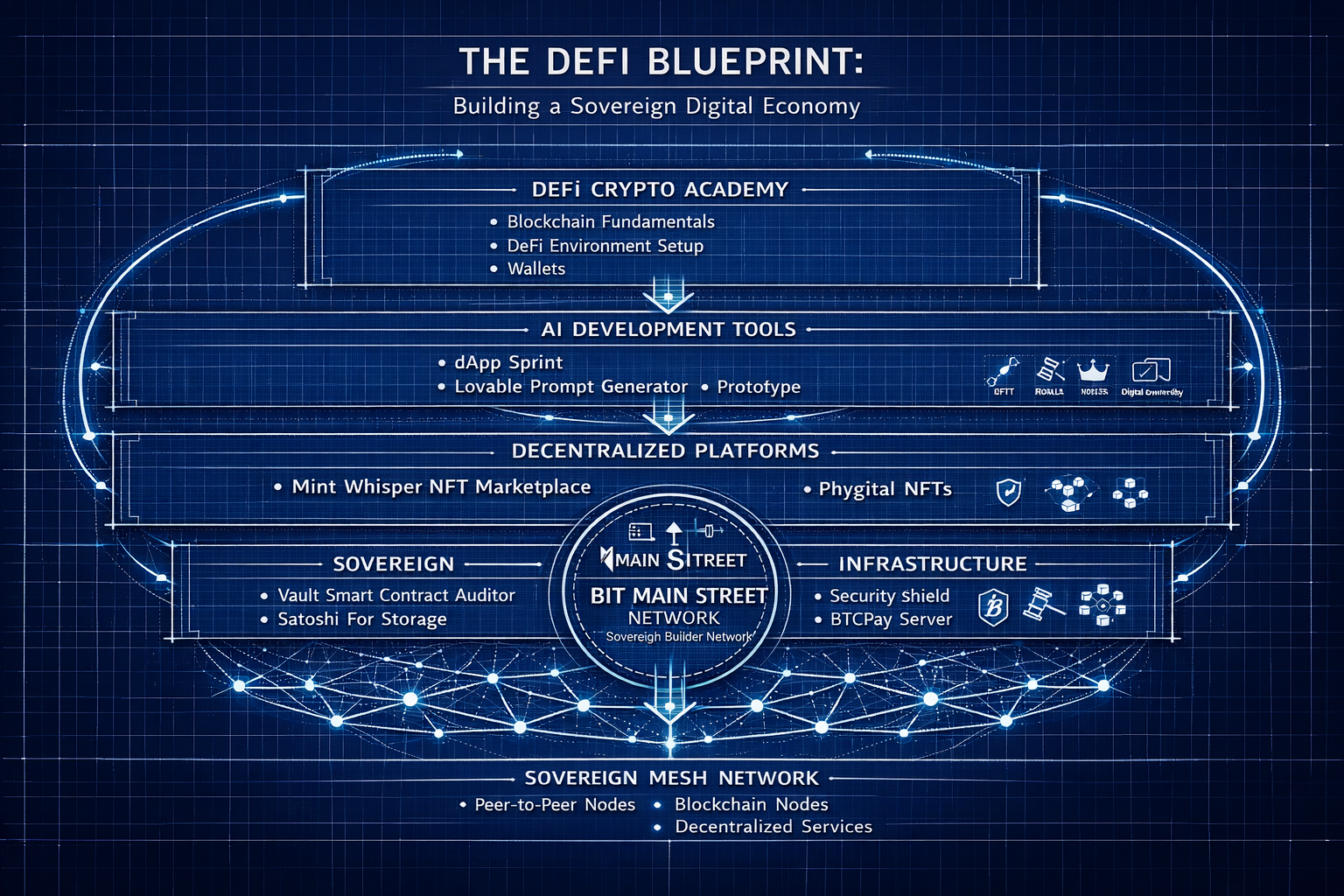
The Blueprint
The Plan for Building a Sovereign Digital Economy
A blueprint is not just a concept. It’s a plan of action — a detailed design that shows how something will be built before the first brick is laid.
Over time I realized that many people are interested in decentralized technology, but very few know where to start. So the question became simple: What would a real blueprint for building a sovereign digital economy look like?
Here’s the plan.
Step One
Learn the Foundations
Before building anything, you need to understand the technology that powers decentralized systems. That’s why the first step in the blueprint is education.
Inside the DeFi Crypto Academy, members learn the core principles behind blockchain and decentralized finance: how blockchain networks operate, how wallets and digital assets work, how smart contracts execute agreements automatically, and how decentralized finance creates new economic models.
Once you understand the infrastructure, you stop seeing the internet as a collection of apps. You begin to see it as a system that can be rebuilt.
Step Two
Turn Ideas Into Applications
Learning is important, but real power comes from building. That’s where tools like dApp Sprint come in.
dApp Sprint is designed to help builders take an idea and turn it into a working application prototype. The system begins with a structured discovery process where an AI assistant helps define the project clearly. The result is a Feeder Document — the blueprint for the application’s architecture, features, and technology stack.
From there, the project moves through structured development cycles until a working prototype is created. Alongside this workflow, builders can also use prompt engineering tools designed to generate structured development prompts for AI application builders like Lovable.
This combination allows ideas to move from concept to working prototype much faster than traditional development.
Step Three
Build Real Platforms
Once you have a working prototype, the next step is transforming it into a real platform.
A good example of this process is Mint Whisper, a full-stack NFT marketplace designed for creators and collectors. The platform allows users to mint NFTs, manage collections, run auctions, and distribute royalties automatically across blockchain networks.
This type of platform shows how decentralized tools can be used to build entirely new digital economies around art, media, gaming assets, and digital ownership. But this is only one example. The same process can be used to build many different types of platforms.
Step Four
Build Your Own Network
The next step in the blueprint moves beyond individual applications. It focuses on infrastructure.
In decentralized systems, power doesn’t come from a single server or company. It comes from networks of independent nodes that communicate and cooperate. Builders who understand this layer can begin experimenting with running nodes, deploying decentralized services, and connecting systems together into what could eventually become a sovereign mesh network.
That is what a sovereign digital economy begins to look like: applications that are decentralized, payments that flow through crypto networks, data storage that can be distributed, and services that run across independent nodes.
Step Five
Build Together
No one builds a new ecosystem alone. That’s why the final piece of the blueprint is community.
Inside the Sovereign Builder Network, members meet regularly to share ideas, discuss new tools, and collaborate on projects that push decentralized technology forward.
Some members are developers. Some are creators. Some are simply curious about where technology is heading. What brings them together is the shared desire to understand the blueprint and help build what comes next.
This is not just about learning technology. It’s about understanding the plan well enough to build something of your own.
That’s the blueprint.