
Why AI Loses the Thread During Long Software Projects - and What We're Doing About It
Why AI Loses the Thread During Long Software Projects - and What We're Doing About It

AI has become remarkably good at helping people build software.
You can describe an application, ask for a database schema, generate code, troubleshoot an error, design a user interface, or get help deploying an application - often within minutes.
But as I've continued developing DappSprint, I've become increasingly interested in a different problem.
What happens when the project lasts longer than the conversation?
That turns out to be a much harder problem.
The Problem Isn't Just Generating Code
Imagine working with an AI assistant on a real business application.
During the first few days, you might make dozens of decisions:
- Which database should we use?
- How should customers authenticate?
- Which payment provider did we choose?
- What information must a customer provide before requesting a quote?
- Which features belong in the first release?
- Which features were deliberately postponed?
- What business rules must the application follow?
Then development continues.
More conversations happen.
More code gets written.
More decisions are made.
Several weeks later, you're working on another part of the application and ask:
"How should we implement this based on what we decided earlier?"
That's where traditional AI conversations can begin to struggle.
The important decision may have been made hundreds of messages ago.
It may have been discussed during a completely different stage of development.
The wording may be different.
Or several possibilities may have been discussed before one was finally selected.
The AI doesn't simply need more conversation history.
It needs project continuity.
Remembering Everything Isn't the Answer
An obvious solution would be to keep feeding the AI everything that has ever happened in the project.
But that's not necessarily intelligence.
That's accumulation.
A months-long software project can contain enormous amounts of information:
- Questions
- Experiments
- Errors
- Abandoned ideas
- Temporary fixes
- Requirements
- Architecture decisions
- User preferences
- Completed tasks
- Future tasks
- Casual conversation
Not all of that information deserves equal importance.
So one of the principles we've adopted while developing DappSprint is:
Don't try to remember everything. Remember what matters.
That means distinguishing between something that was merely discussed and something that actually became important to the project.
But Memory Alone Still Isn't Enough
There's another problem.
Suppose an AI remembers that earlier in the project someone said:
"Maybe we should use Stripe."
Later, another decision is made and a different payment solution is officially selected.
Which one should the AI trust?
Simply finding an old statement isn't enough.
A useful development assistant needs to distinguish between:
- Something that was discussed
- Something that was suggested
- Something that was decided
- Something the project officially requires
- Something that has since been changed
That distinction becomes increasingly important as AI moves from answering isolated questions toward participating in real, long-running business projects.
Relevant information isn't necessarily authoritative information.
The AI Also Needs to Know Where You Are
There's another side of the problem that has less to do with memory and more to do with orientation.
A large application may contain dozens of development tasks.
At any moment, the user should be able to answer:
What am I building?
Where am I in the process?
What are we working on right now?
What have we already decided?
What does the system need from me?
What happens next?
This has become a major part of the DappSprint design.
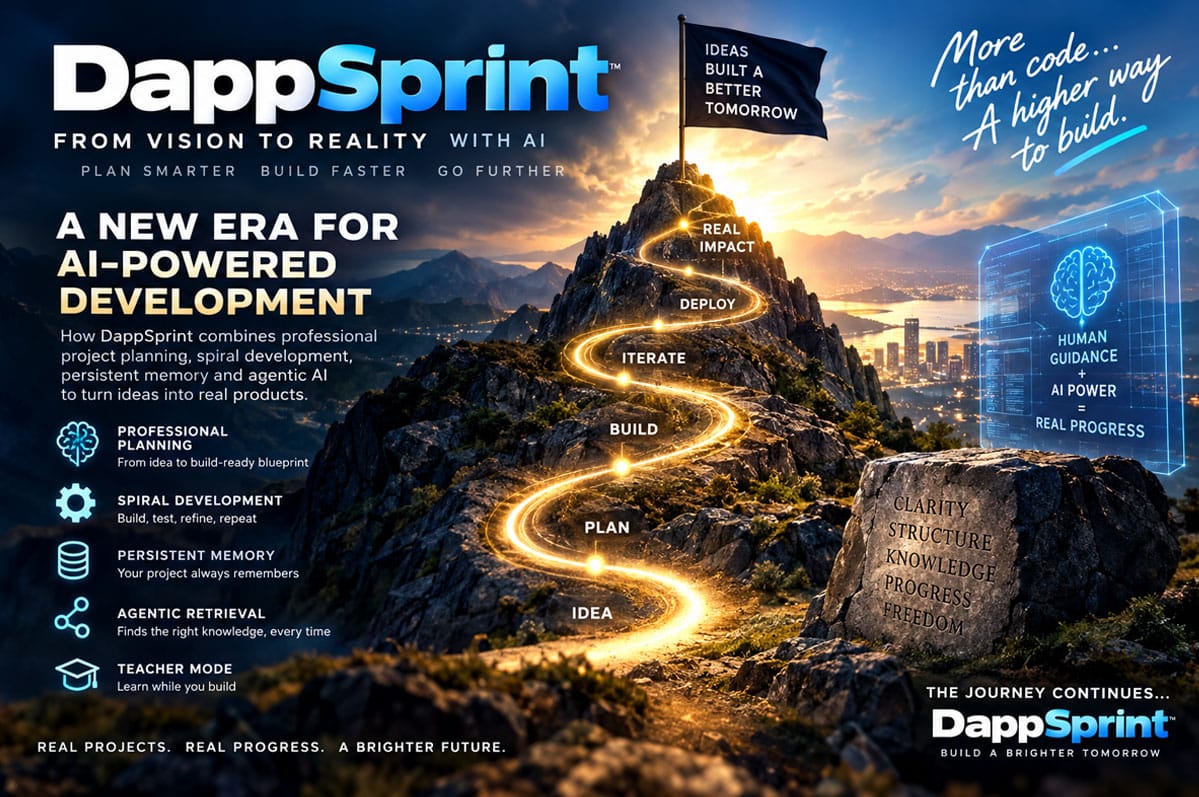
Instead of putting an entire software project into one giant AI conversation, DappSprint organizes development into a visual, guided process.
The user can see the larger development path while concentrating on the work immediately in front of them.
The goal is simple:
Keep the big picture available without making the user carry the entire project in their head.
Finding the Right Previous Decision
We've also been working on another capability.
Suppose you're much later in a project and ask:
"Can we send these customer notifications late at night?"
Earlier in the project, the actual requirement might have been written as:
"Automated customer messages cannot be sent after 8 PM."
Those sentences don't share much wording.
But they mean almost the same thing.
A useful project assistant should be able to recognize that relationship, locate the earlier decision, and use it when helping with the current task.
That becomes especially valuable when a project has been running for weeks or months.
The user shouldn't have to remember exactly how something was worded.
And they shouldn't have to search through dozens of previous conversations looking for it.
Sometimes the Correct Answer Is: "I Don't Know Yet"
This may be one of the most important lessons.
Imagine that the project established which payment provider to use, but never established what percentage commercial customers should pay as a deposit.
Later someone asks:
"Configure the commercial deposit using the percentage we decided on."
There is a dangerous answer:
Invent a reasonable percentage and continue.
There is a much better answer:
Search the project's existing knowledge.
And if the answer still isn't there:
Ask the user.
That's the behavior we're working toward with DappSprint.
If the project already knows the answer, find it. If the project doesn't know the answer, ask. Don't guess.
For business software, that distinction matters.
A made-up number, requirement, permission, workflow, or business rule can eventually become real code.
From AI Coding Assistant to Development System
This is part of a larger direction for DappSprint.
I don't want DappSprint to simply become another place where someone types:
"Build me an app."
The objective is a structured development environment where AI assists throughout the project while the project itself remains organized.
The process begins by understanding the business or application.
That understanding becomes a structured project definition.
The project moves into a development plan.
The user works through that plan incrementally.
Important project knowledge can persist beyond individual conversations.
And when previous information becomes relevant again, DappSprint can bring that information back into the current work.
The result we're pursuing is something closer to:
Discover → Define → Plan → Build → Remember → Retrieve → Validate → Launch
with the user remaining in control throughout the process.
Why This Matters Beyond Developers
This problem is particularly important to me because DappSprint isn't intended only for experienced software engineers.
Consider a small-business owner who wants to create a custom application.
They may understand their business extremely well while knowing very little about:
- Databases
- APIs
- Authentication
- Deployment
- Application architecture
- Software-development workflows
They shouldn't also have to become experts in managing AI context.
They shouldn't need to know which conversation contained a decision from three weeks ago.
And they shouldn't need advanced prompt-engineering skills just to keep an application project moving in the right direction.
The system should shoulder more of that organizational burden.
One Clear Next Action
That leads to another principle behind DappSprint:
One clear next action.
AI can produce enormous amounts of information very quickly.
Sometimes that's useful.
Sometimes it simply creates another problem: the user doesn't know what to do first.
DappSprint is being designed so the underlying system can understand a much larger project while presenting the user with a much smaller immediate decision.
Where are you?
What are you working on?
What information matters?
What do you need to do next?
That is the experience we're trying to create.
Where DappSprint Is Going
We're continuing to test these ideas as DappSprint moves from architecture into real project usage.
There will undoubtedly be lessons that only appear after the system has been used across more businesses, longer builds, and more complicated applications.
That's exactly what I want.
The next stage isn't simply adding more AI.
It's learning where AI actually helps people complete projects — and where structure, memory, verification, and human judgment matter more.
Because the future of AI-assisted software development may not belong to the system that can generate the most code in the shortest amount of time.
It may belong to systems that can stay oriented long enough to help people actually finish what they started.
DappSprint is being developed by Bit Main Street LLC as a structured AI-assisted software-development system for turning ideas and business requirements into organized, guided application projects.
DappSprint - Know what you're building. Know where you are. Remember what matters. Take one clear next action.